Blog
From Raw Data to the Dashboard: Thoughts on an Industrial Project
· 6 min read
Data analysis, database integration, API development, and frontend creation. I had the opportunity to carry out all of these tasks for a leading manufacturer of high-precision analytical equipment.
Read more →
From Subjectivity to Polycontextural Logic
· 18 min read
Subjectivity means different observers reach different yet valid conclusions. Gotthard Günther’s polycontextural logic turns that into a formal account of self-reflection, and shows why today’s mono-contextural AI cannot manage it. Two network models of consensus and graph colouring make the idea concrete.
Read more →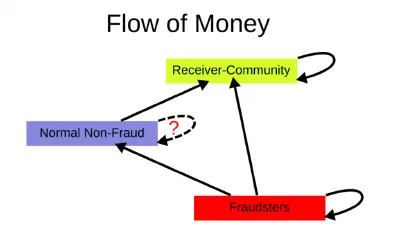
Reading the Money Flow: Winning the Bremen Big Data Challenge 2025 Without a Black Box
· 4 min read
Winning the 2025 Bremen Big Data Challenge anti-money-laundering track with an F1 of 0.9992, by reading network structure instead of training a black-box model.
Read more →Structural Insulators: When a Shortcut Makes a Network Harder to Coordinate
· 7 min read
Small-world shortcuts are supposed to help distributed systems coordinate. However, in a graph-colouring task they can do the opposite: depending on their length and on the local heuristic, added links act as promotors or as insulators that block a global solution.
Read more →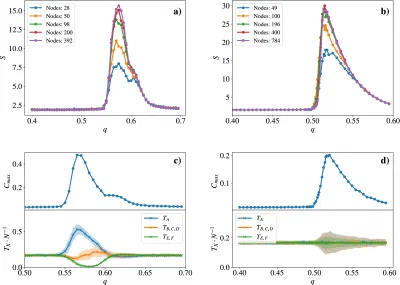
Stable Misunderstandings: Consensus Without a Common Truth
· 11 min read
Agents that each perceive the world through their own logic can still reach consensus. Whether they do is governed by a single parameter, and whether the consensus they reach means anything at all is governed by the shape of the network they sit in.
Read more →Two Observers, Two Truths: Why Physics Runs on Transformations
· 8 min read
Two observers measure the same experiment and get contradictory results — both correct. Gotthard Günther's polycontextural logic explains why physics needs transformations.
Read more →When the Environment Remembers: Memory Effects in Synthetic Biology
· 9 min read
Why a genetic module behaves differently inside a cell: the environment has a memory. We compute that memory kernel exactly by mapping reaction chains onto random walks.
Read more →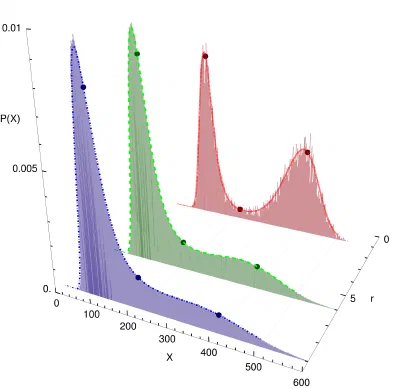
Burst Noise Can Create and Destroy Bistability in Chemical Systems
· 8 min read
Burst noise can create or destroy bistability in a one-dimensional chemical system without changing its deterministic equations.
Read more →How the Drive Shapes Self-Organized Criticality — and When It Doesn't
· 8 min read
Changing where grains enter an Abelian Sandpile can preserve criticality (α ≈ 1.021) or destroy it via a percolation transition at p_c ≈ 0.58.
Read more →