Structural Insulators: When a Shortcut Makes a Network Harder to Coordinate

In networks solving a distributed differentiation task, added shortcuts can speed convergence up or block it entirely. Which one happens depends on the length of the link and on the decision heuristic — with consequences for how regional solutions become globally incompatible standards.
Quicklinks
- Paper (2024): Structural Insulators and Promotors in Networks Under Generic Problem-Solving Dynamics — Advances in Complex Systems (open access, arXiv:2301.10550)
Different regions of the world settled on incompatible plug sockets and industries converged on incompatible file formats. In both cases every participant made a locally sensible decision, every region ended up internally consistent, and the result is a standoff that nobody chose and nobody can unilaterally fix.
There is a clean abstract version of this. Give the nodes of a network a task that requires them to differentiate from their neighbours, let each node decide using only local information, and watch what happens. Regional solutions appear, they are locally valid, but they do not always fit globally.
The question we asked is what the network structure contributes. The intuition is that shortcuts (additional long-range links) should help to organize the convergence. A link that reaches across the network couples distant regions and should let them align before they harden. Turns out: That intuition is often wrong.
- The task: distributed graph colouring on ring graphs, where each node sees only its neighbourhood and must end up differentiating from them. Trivially solvable globally, genuinely hard locally.
- The failure mode: ordering avalanches start in several places at once, producing regions that are internally valid and mutually incompatible, e.g. ABAB here, BABA there.
- The result: added shortcuts are not always helpful. Depending on their length and on the decision heuristic, they act as structural promotors that accelerate a solution or as structural insulators that make the network harder to solve.
- Solution times differ by an order of magnitude between evolved hard and easy networks with the same number of nodes and links.
The task
Let us start with three definitions:
- A graph is coloured if every node has been assigned a colour.
- A graph is validly coloured if no two adjacent nodes share a colour.
- The chromatic number is the smallest number of colours with which a graph can be validly coloured.
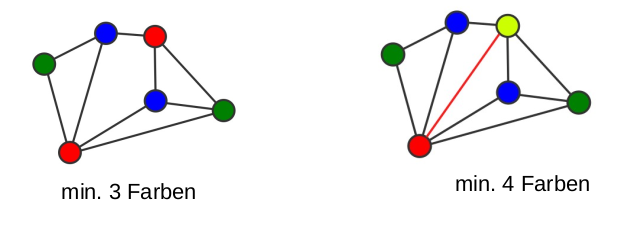
Determining the chromatic number and producing a valid colouring are both presumed hard in general (NP-hard and NP-complete respectively), so we only used graphs where the answer is obvious: ring graphs with an even number of nodes, trivially coloured ABAB, with chromatic number k = 2.
Graph Coloring is a differentiation task rather than a conformity task, which makes it the complement of a consensus model we studied alongside it, where agents wanted to match their neighbours. Here each node wants to be distinguishable from them. However, the framework is the same: local information, no global view, no arbiter.
A conventional algorithm solves the ring without effort. Start anywhere, pick either colour, and the constraint propagates outward as a single wave. Our nodes do not get to do that. Each is its own decision-maker, with information about its immediate surroundings only, using a local heuristic — the kind of dynamics introduced by Hadzhiev et al. (2009) for conflict-free resource planning in distributed systems.
Locally correct, globally incompatible
The difference from the global algorithm shows up immediately. Instead of one wave, ordering attempts start in several places at once, because a node in one region cannot detect that an specific coloring has already begun somewhere else.
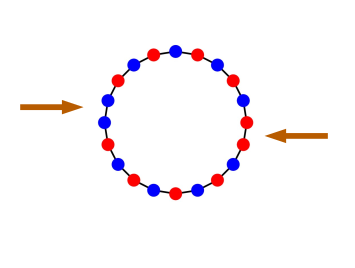
The coloring-avalanches routinely produce solutions that are valid locally and incompatible globally. One region settles into ABAB, another into BABA, and neither side was doing anything wrong. This is the plug-socket situation in miniature, and it is why the model is a reasonable abstraction of how technological standards diverge.
Getting to a global solution means resolving these boundaries, and how long that takes is the observable we measured.
Shortcuts cut both ways
We added small-world shortcuts to the ring and asked how they help to solve the Graph Coloring Problem.
To answer that without guessing, we evolved the networks: starting from a ring, we added and rearranged a fixed number of links, selecting for either fast or slow convergence. What comes out is a pair of networks with identical node and link counts that differ only in where the shortcuts sit.
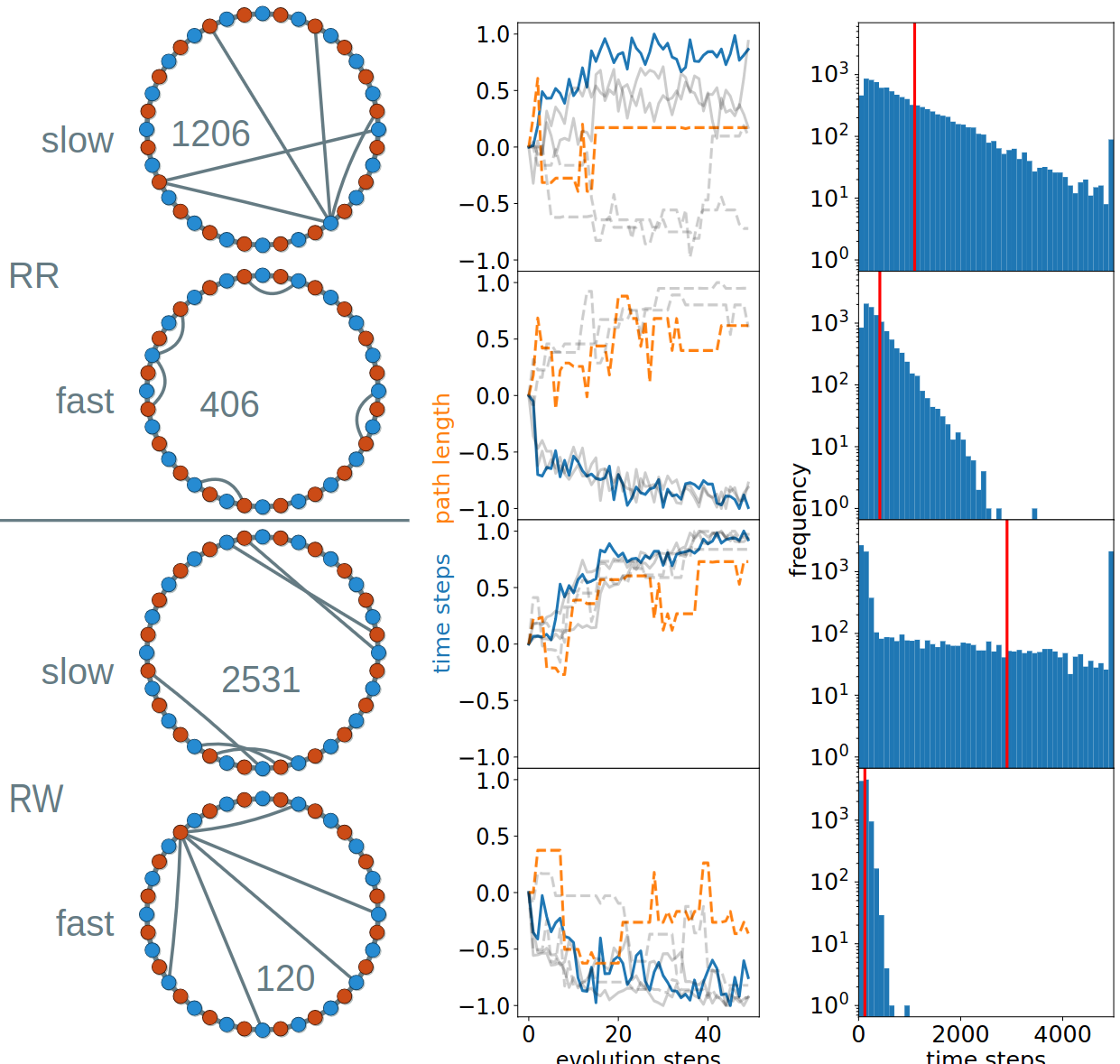
The difference is not subtle. Between the evolved hard and easy variants, mean solution times differ by roughly an order of magnitude. The finding that matters is that there is no single answer for which shortcut helps the most. Depending on the length of an added link and on the details of the decision heuristic, a shortcut acts as:
- a structural promotor, coupling regions early enough that their emerging solutions can still be reconciled, so convergence accelerates; or
- a structural insulator, which does the opposite and makes the network harder to solve.
That is why the result cannot be reduced to “more connectivity is better”. Connectivity delivered at the wrong scale relative to how the local dynamics propagate is worse than no connectivity at all.
What this is good for
The immediate consequence is diagnostic. If you have a distributed system that coordinates badly, adding links is not automatically a fix, and the useful question is not how many connections exist but how long they are relative to the range over which local decisions spread.
For distributed decision systems of any kind, including the multi-agent arrangements now common in machine learning, that is an uncomfortable but useful result. Topology is not a deployment detail that can be tuned afterwards. It is one of the things that determines whether a global solution is reachable at all.
Frequently Asked Questions
What is a structural insulator?
An added link in a network that makes a distributed coordination task harder rather than easier. Shortcuts are usually assumed to help by coupling distant regions. In our graph-colouring dynamics, depending on their length and on the local decision heuristic, they can instead lock in a conflict between regions that have already settled on incompatible local solutions.
Why do locally valid solutions end up globally incompatible?
Because nodes act on local information only, ordering avalanches start in several places simultaneously. One region settles into ABAB and another into BABA. Each is valid internally, neither node at the boundary is making an error, and nothing local distinguishes the two conventions.
Does adding more connections help a distributed system coordinate?
Not reliably. What matters is the length of the added links relative to the range over which local decisions propagate, and the details of the heuristic the nodes use. The same number of shortcuts can produce solution times differing by about an order of magnitude depending only on where they are placed.
How does this relate to technological standards?
The model abstracts the situation in which regional solutions emerge independently and turn out to be mutually incompatible — different plug sockets, different file formats. The dynamics show that this is the expected outcome of local decision-making, not an accident, and that network structure determines whether it can still be resolved.
References
- Hadzhiev, B., Windt, K., Bergholz, W., Hütt, M.-T., 2009. A model of graph coloring dynamics with attention waves and strategic waiting. Adv. Complex Syst. 12, 549–564. https://doi.org/10.1142/S0219525909002386