Stable Misunderstandings: Consensus Without a Common Truth

We built a model of agents striving for consensus without any shared notion of right or wrong. One parameter — how much friction an agent tolerates before revising its world-view — decides between an unordered phase and an emerging shared signalling framework. The clusters that form include neighbours who understand each other incorrectly but stably, and whether those can exist at all depends on the cycle structure of the network.
Quicklinks
- Paper (2022): Collective Patterns and Stable Misunderstandings in Networks Striving for Consensus Without a Common Value System — Scientific Reports
Almost all models of collective behaviour are based on an assumption so basic that it is easy to miss: The exchanged signals have the same meaning for every agent, and a shared value system decides whether a sentence is right or wrong. If this assumption gets dropped, it is not obvious that anything collective can happen at all. Or as a question: if observations are perceived different by every agent, can consensus still emerge?
Our model shows: It does, but only in a particular regime, and the boundary of that regime turns out to be a phase transition.
- In our model, no shared truth is assumed. Each agent has its own worldview, implemented as a translation table; our communication model contains no definition of right or wrong, and hence an observation that is correct for one agent can be wrong from the perspective of another agent.
- One parameter decides. A threshold on how much accumulated friction an agent tolerates before discarding its world-view separates an active phase, where agents change beliefs constantly, from a frozen phase in which nothing moves.
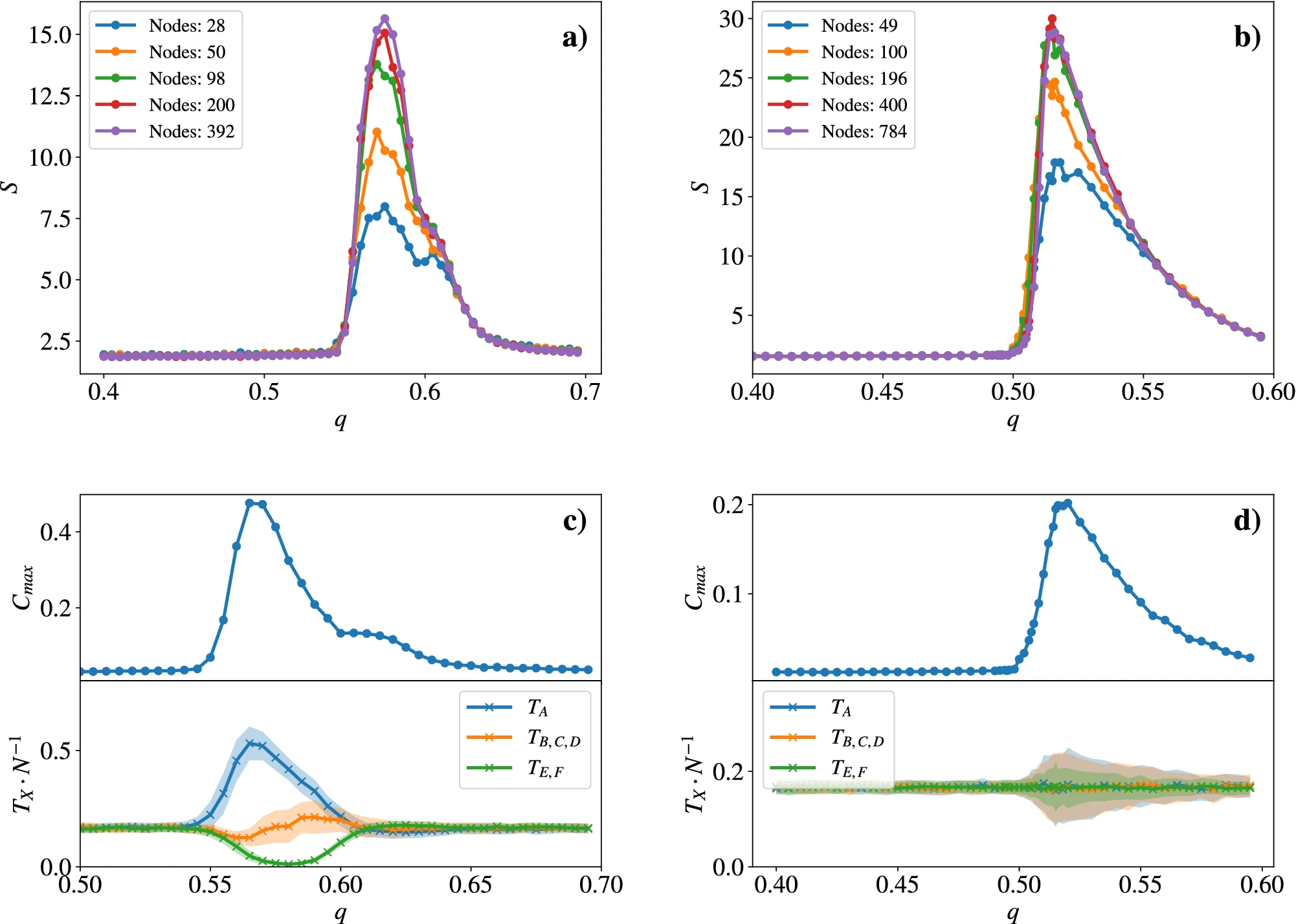
- Consensus lives in between. Clusters nucleate and grow only in the window between the two phases. The mean cluster size peaks sharply at the critical point and keeps growing with the system, which is what makes this a phase transition rather than a crossover, and the clusters are self-similar.
- Stable misunderstandings. Some clusters do not share a convention at all. Neighbours hold different but compatible tables: they misunderstand each other, permanently and without friction.
- The network topology decides whether misunderstandings are possible. Stable misunderstandings require even cycles. A triangle can only come to rest if all three agents genuinely agree; a four-ring can come to rest on three different world-views.
A model with no global notion of “right/wrong”
In our model, agents form the nodes of a network. Each agent has one observable attribute, a colour, though the colour stands in for an attribute of any kind, including an opinion or a conviction.
Every agent strives for conformity: it wants to have the same colour as what it sees around it. From a social-psychological angle this conformity can be motivated by a plain need to belong.
However, besides the colour, each agent carries its own translation table, that maps the observed (external) colour onto the perceived (internal) colour. Hence, what one agent perceives as the colour of another agent is not necessarily the same color that an agent would perceive when also looking at .
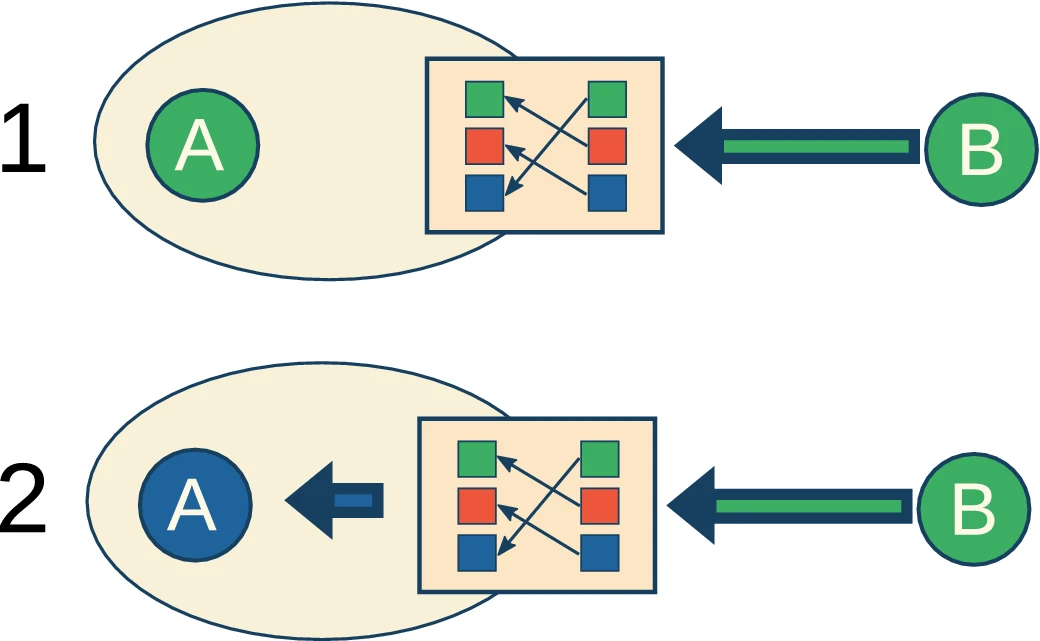
The dynamics are as simple as the setup. An agent is selected at random, it observes a direct neighbour through its own observation table, and it recolours itself to whatever it subjectively understands as conforming.
The consequence of the missing shared truth: An agent that observes a neighbour and finds a mismatch has no way to tell whether the neighbour is signalling (from an external view) something different or whether only its own translation table is translating badly. There is no external reference to compare with.
If this model is run, nothing converges. Every agent behaves impeccably by its own lights and strives for conformity, but the system as a whole goes nowhere.
The one thing we added
We now give each agent a single additional capability: it records how often an observation of neighbours has resulted in a color change. The idea behind this: If a globally valid logic existed, neighbours would settle quickly and changes would stop. A persistently high rate of change is therefore an indirect signal that the agent’s own table does not fit its surroundings. When the rate stays high, the agent discards its table and generates a new one.
Note what this rule does not do: No agent inspects anyone else’s worldview and no agent is told what the correct convention is. Rather, each one tracks its own interaction history and draws a conclusion about itself.
Concretely, each agent keeps two counters: records every observation it makes, records those that forced it to recolour. When the ratio exceeds a threshold , the agent throws its translation table away, draws a new one at random from the possibilities, and resets both counters. That threshold is the model’s single free parameter.
Three phases, and consensus only in the middle one
For small the agents are hyper-responsive. Almost any disagreement counts as evidence against their own table, so tables are discarded constantly and nothing has time to stabilise. There is too much activity in the system for any cluster of shared world-views/beliefs to survive.
For large the agents are stubborn. Almost no revision happens, every agent keeps whatever table it started with, and the mutual incomprehension of the previous section simply persists. There is too little activity for clusters to form at all.
Between the two extremes, a shared signalling framework emerges: convention-aligned clusters nucleate and grow. The window is bounded on the left by a critical value , where the size of the largest cluster jumps abruptly, and on the right by a value above which the system is too sluggish for a nucleus to appear at all.
The two edges are not alike. At the change is sudden — the largest cluster goes from nothing to spanning a substantial fraction of the system. Towards it decays smoothly. In between, what happens is a competition: incompatible nuclei appear in several places at once and grow until they run into one another. It is the same process as grain growth in a crystallising metal, and the resemblance is close enough that the Potts model is the natural point of comparison.
The clusters are also self-similar. Just above their size distribution follows a power law with exponent , and the largest cluster grows with the linear system size as : with on the triangular lattice, where clusters are compact with a smooth boundary, and on the square lattice, where the boundary is ragged.
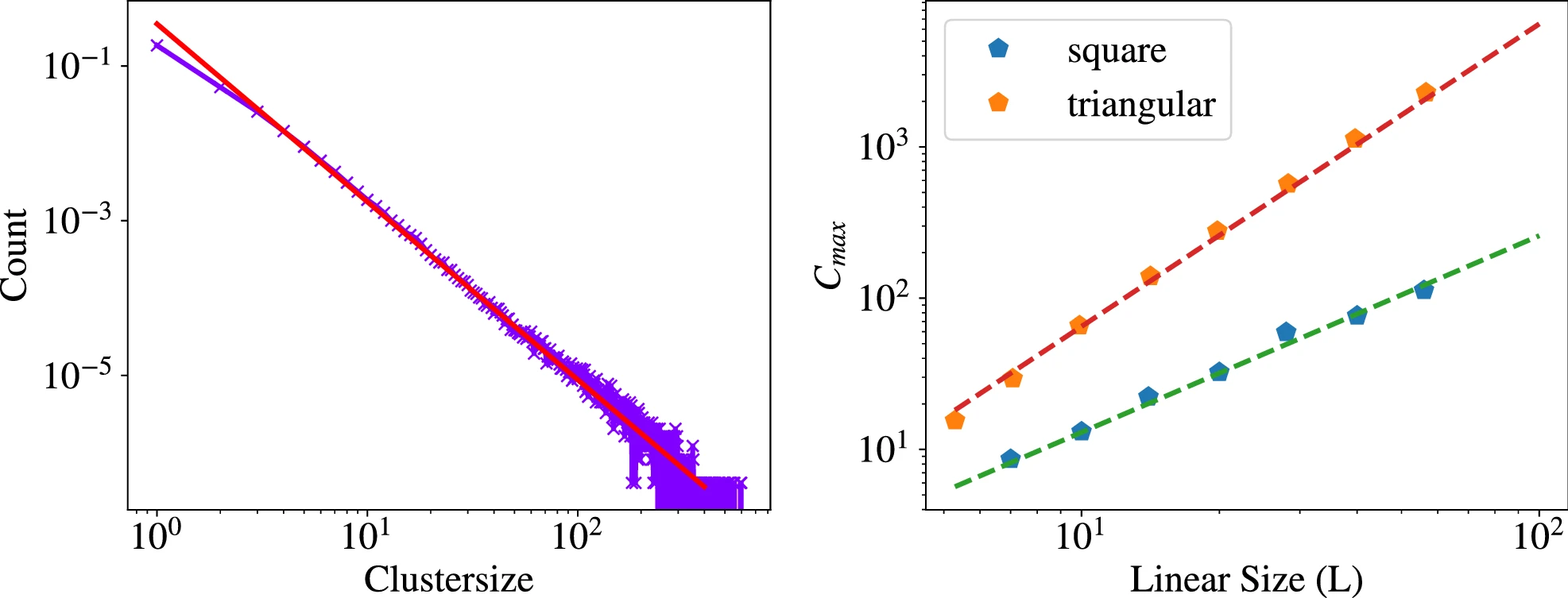
Translated back into social terms: the structure of opinion in a small community is the same structure you find in a large system of interconnected communities.
Stable misunderstandings
The result we expected: every agent in the cluster ends up holding the same set of conventions, hence the same translation table. However, we also observe a second kind. Neighbouring agents hold different tables that happen to be compatible. Each translates the other’s signal into something that satisfies its own conformity criterion. No friction accumulates, so neither has any reason to revise. The configuration is stable precisely because the misunderstanding is invisible from inside it.
We called these stable misunderstandings. They are not a failure of the consensus mechanism; they are produced by it, and they are indistinguishable from real agreement by every signal available to the participants. A cluster can look converged from the inside while containing no shared meaning at all.
The condition that produces them is the absence of a referee: no shared notion of right and wrong against which a translation could be checked. Wherever that condition holds, this outcome should be expected rather than treated as a pathology.
Whether they can exist at all is a property of the network
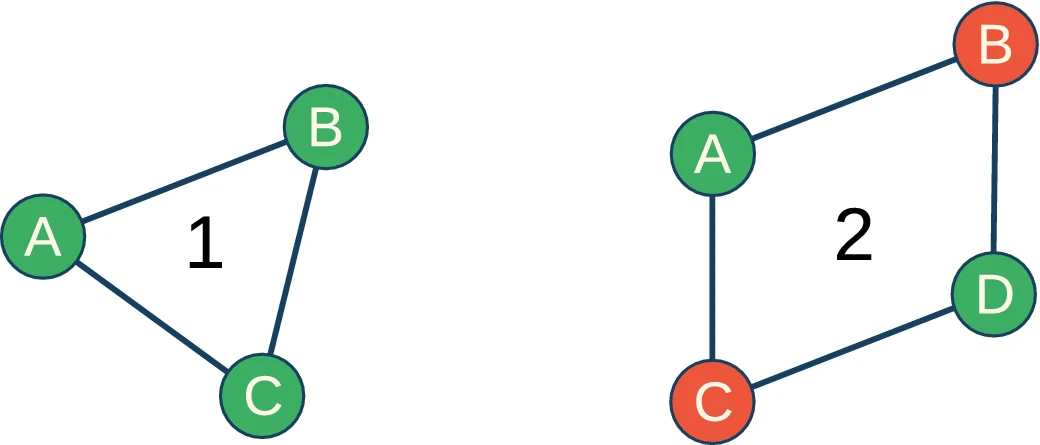
Take three agents in a triangle. For every connected pair to be mutually compatible, all three tables must agree and each must be its own inverse. But going once around the triangle must also cancel out, and the only matrix satisfying both conditions is the identity. A triangle can come to rest only if all three agents genuinely hold the same world-view.
Now take four agents in a ring (a square). B and C are no longer directly connected; they meet only through D. The constraints do not force any single table to be the identity. The system comes to rest, no agent perceives a conflict, and the world-views differ. Stable misunderstandings need even cycles; odd cycles destroy them.
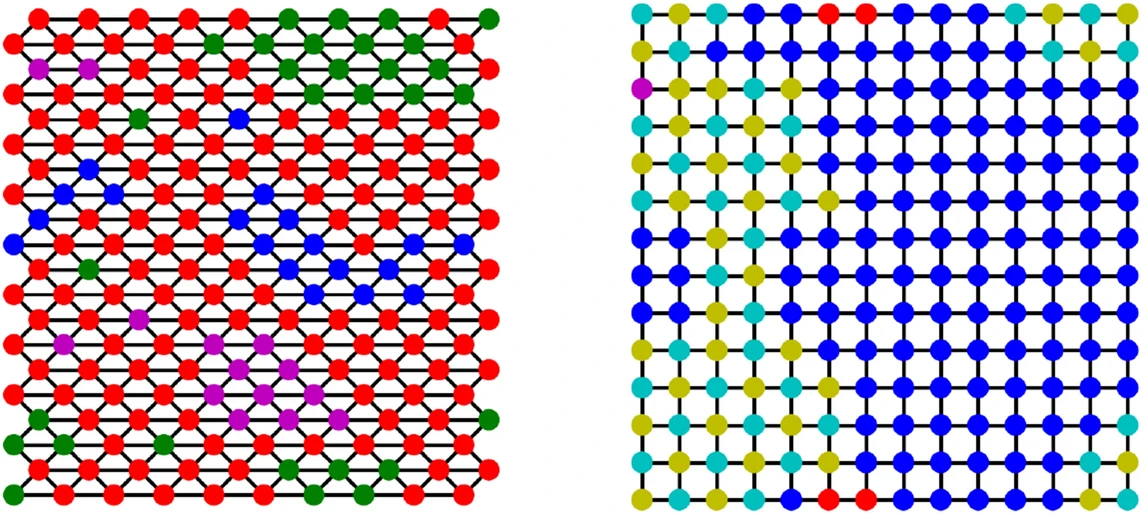
This is not a curiosity of the four-node case. It survives all the way up. Near on the triangular lattice, the clusters consist almost entirely of agents holding the identity table, a real agreement. The same dynamics on the square lattice produce the repeating alternating patterns above: large regions in which nobody perceives a conflict and nobody shares a world-view.
Which of the two a community ends up in is therefore not a fact about the agents, their stubbornness, or the quality of their communication. It is a fact about the cycle structure of the network they sit in.
Why this matters beyond the model
The model is minimal by design and is not a model of any specific real system. What it establishes is a proof of principle for the following argument: instances operating on genuinely different logics can converge on a shared one, without any global arbiter, provided a mechanism for self-directed revision exists.
It also says something sharper than “communication helps”. Consensus requires a specific and non-obvious balance. Agents too willing to revise never stabilise; agents too unwilling never move. The capacity for self-doubt is useful only in a narrow band, and the width of that band is a property of the system, not of any individual in it.
Frequently Asked Questions
Can consensus emerge without a shared notion of right and wrong?
Yes, but only in a particular regime. In our model agents cannot distinguish correct from incorrect observations, and a shared signalling framework nevertheless emerges — provided the agents’ willingness to revise their own conventions sits between the two extremes of constant revision and no revision at all.
What is the phase transition in this model?
A single threshold parameter governs how much accumulated friction an agent tolerates before discarding its world-view. Small produces an active phase in which agents change beliefs constantly; large produces a frozen phase in which almost nothing changes. Clusters build up only in the window between the two. The mean cluster size peaks sharply at the critical point and keeps growing with system size there, which is what distinguishes a phase transition from a crossover.
What is a stable misunderstanding?
A cluster in which neighbouring agents hold different but compatible conventions. They do not share a logic, but the mismatch never produces friction, so neither agent has a reason to revise. From inside the cluster it is indistinguishable from genuine agreement.
Does the structure of the network matter?
Decisively. Stable misunderstandings require even cycles: a triangle of mutually connected agents can only come to rest if all three hold the identical world-view, while a four-agent ring can come to rest on three different ones. The effect carries over to large systems — near the critical point, clusters on a triangular lattice are built from genuine agreement, whereas the same dynamics on a square lattice produce large regions of stable misunderstanding.
How is self-reflection implemented?
Each agent counts its observations and, separately, those that forced it to change. When the ratio of the two exceeds the threshold q, that is an indication that its own table does not fit its surroundings, so it discards it and draws a new one at random. No agent inspects another’s logic and none is told the correct answer — each draws a conclusion about itself from its own interaction history.