How the Drive Shapes Self-Organized Criticality — and When It Doesn't

We show that the drive of the Abelian Sandpile model is a hidden tuning parameter: depending on where grains are deposited, self-organized criticality either survives untouched (α ≈ 1.021 ± 0.033) or is destroyed by a percolation transition at p_c ≈ 0.58.
Quicklinks
Self-organized criticality holds a certain fascination for physicists: It is the phenomenon that specific dynamic systems tunes itself toward a critical state. Small changes or fluctuations can then have no effect or cause drastic reactions. A vivid example is the sandpile model. If (theoretical) grains of sand are dropped onto a grid and a relatively simple local rule is applied, the system converges precisely to a state that lies on the boundary between order and chaos. Each additional grain of sand is likely to remain in place or trigger a small avalanche, but sometimes it also triggers a large, system-wide avalanche.
Since Bak, Tang, and Wiesenfeld introduced the sandpile model in 1987, its behavior has been studied from nearly every angle: various topple rules, different geometries of the underlying grid, conservative versus dissipative dynamics, … And yet one question still seems to remain unanswered: What happens if one changes the way the system is driven, that is, if one modifies the normally random placement of sand grains?
This is precisely the question that Marco Winkler, Wolfgang Kinzel, and I wanted to answer.
- Favor-3 drive: the critical exponent α ≈ 1.021 ± 0.033 is unchanged — SOC survives even a highly structured drive targeting pre-critical sites.
- Favor-2 drive: 73% of sites reach height three, crossing the percolation threshold (p_c ≈ 0.58) and destroying power-law avalanches entirely.
- The drive is a hidden tuning parameter: where energy enters a critical system can determine whether SOC exists at all.
What Makes a Sandpile Critical?
The Abelian Sandpile model (due to Dhar, 1990) is defined on a square lattice. Each site can hold a number of grains, which is called its height. In each time-step, a randomly chosen site receives one new grain. Once a site reaches a minimum height of four, it topples: it distributes its four grains: one to each neighbor. If those neighbors reach also reach a height of at least four, they also topple, generating an avalanche. Grains that fall off the boundary are lost (the dissipation of the system).
The remarkable property, first described by Bak, Tang, and Wiesenfeld in 1987, is that the system self-organizes into a critical state in which avalanche sizes follow a power law,
without any parameter being tuned. In the standard model, each grain lands on a randomly chosen site, regardless of the current state of the system. But what if the drive depends on the current state of the system?
A Drive That Pays Attention
Our modification of the Abelian Sandpile model is deliberately minimal. We kept the toppling rules untouched and changed only the drive. Instead of depositing at a random site, the drive now targets sites of a specific height . If at least one site of height exists, the grain goes there (chosen randomly among all such sites); otherwise the drive falls back to random selection.
We call these the favor- models. It turns out (and this was to be expected) that this modification changes the system’s behavior. However, the way the behavior changes is, in some cases, quite unexpected. In some cases, the system retains its critical state; in others, it is destroyed.
Four Drives, Four Fates
Targeting Pre-Critical Sites Leaves Criticality Intact
The favor-3 drive preferentially deposits grains onto sites already at height three, hence creates an immediate toppling. Potential critical areas are thus eliminated as soon as they arise. We therefore hypothesized that no global critical state can arise here and that SOC is effectively prevented.
But it doesn’t. The avalanche-size distribution remains a clean power law, with the same critical exponent as the original model:
The steady-state distribution of site heights is nearly identical to the analytically known result. By every statistical test we applied, the favor-3 model is indistinguishable from the original sandpile model in its steady state.
The drive constantly triggers the most volatile sites, yet the self-organizing dynamics absorb this perturbation completely and arrive at the same critical fixed point.
The Transient Tells a Different Story
Even though the steady states match, the transient to that steady state differs. In the standard model, grain density grows uniformly across the lattice (because the drive is random).
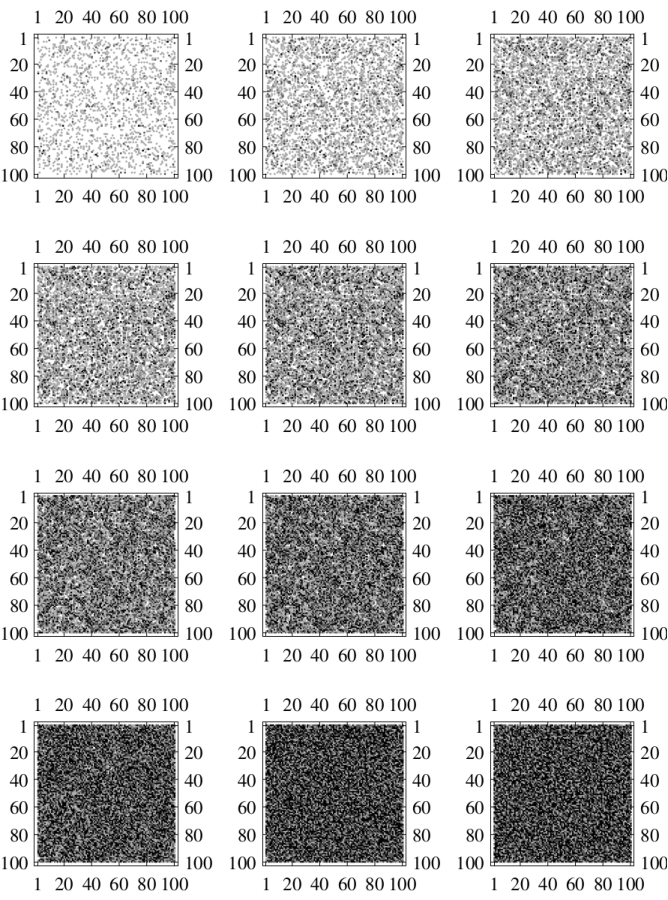
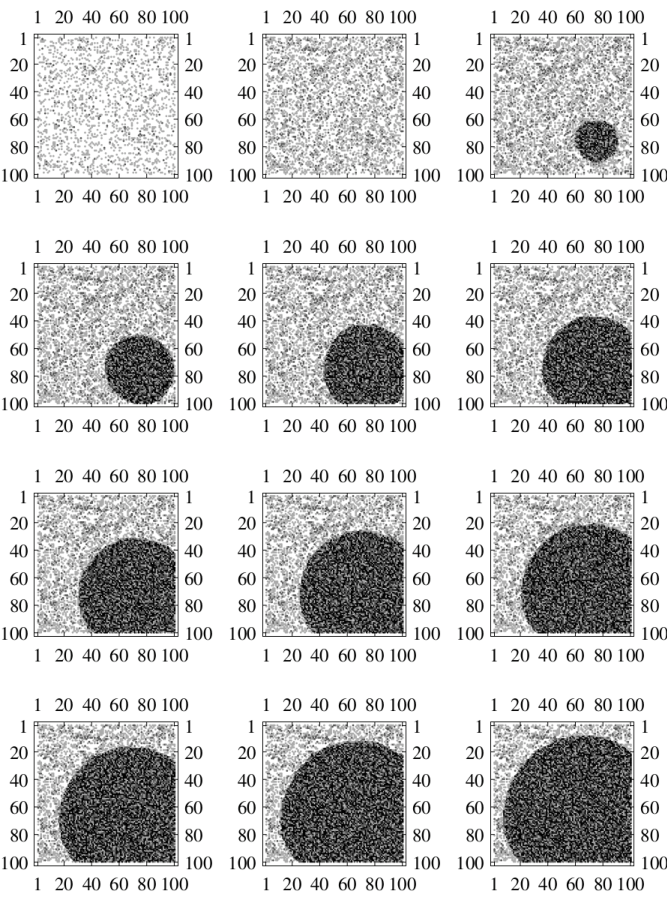
In the favor-3 model, the very first site to reach height three triggers an immediate avalanche. This local event creates a small density excess in the neighborhood, which raises the probability of another height-3 site appearing nearby, which triggers another avalanche. A condensation nucleus forms and propagates outward as a coherent, roughly circular wave of high density until it covers the entire system.
How the Favor-2 Drive Destroys SOC
The favor-2 drive deposits grains onto height-2 sites. In this case, the consequence for the system is drastic: Small and intermediate avalanches disappear entirely: most avalanches span the whole system.
To investigate this, we conducted a separate experiment: We prepared a lattice in which a proportion of the lattice points was randomly set to height three, and measured the expected avalanche size as a function of . The result is a sharp phase transition at
close to the known site-percolation threshold on the square lattice (, Jacobsen, 2014). Above this threshold, a percolating cluster of height-3 sites spans the system. As soon as one of these cluster-sites topples, an avalanche percolates the full system.
In the favor-2 steady state, 73% of sites have height three, which is clearly above .
Favor-1 and Favor-0: The In-Between Cases
Both the favor-1 and favor-0 models show no signatures of a critical system.
The favor-1 model produces a bimodal distribution: many small avalanches and some system-spanning ones, with almost nothing in between. A similar percolation logic as for the Favor-2 drive applies. In a {2,3}-height reference system, the critical value of is . The favor-1 steady state sits right at the percolation transition, producing both finite and infinite avalanches simultaneously.
The favor-0 model, which always fills empty sites first, shows avalanches on various scales, but the distribution of these avalanches does not follow a power-law.
What This Means for Real-World Complex Systems
SOC is robust, but not against all drives. The favor-3 result shows that even a highly structured, state-dependent drive can fail to disturb the critical fixed point. But the other results demonstrate that the wrong drive can destroy criticality entirely, purely by biasing where grains enter the system.
The drive is a hidden tuning parameter. In most treatments of SOC, the drive is considered a background process that merely keeps the system fed. In any real-world system claimed to exhibit SOC — earthquakes, neural avalanches, financial markets — one should therefore ask: is the input process neutral, or does it preferentially target certain states? The answer could determine whether and how SOC is present.
Percolation is a key mechanism. The transition from critical to non-critical behavior maps cleanly onto a percolation threshold. Measuring the steady-state density of height-3 sites and comparing it to allows for a quantitative statement about the system’s criticality. This connects to my broader research on complex systems and network science.
Frequently Asked Questions
What is self-organized criticality (SOC)?
A dynamical system exhibits SOC when it evolves toward a critical state without external parameter tuning, producing events of all sizes with power-law statistics P(s) ~ s^{-α}. The concept goes back to Bak, Tang, and Wiesenfeld (1987).
What is the Abelian Sandpile model?
A lattice model, formalized by Dhar (1990), in which grains are deposited and sites topple above a threshold height. Because toppling events commute, the model is analytically tractable and serves as the canonical SOC example; see Pruessner’s textbook for a comprehensive treatment.
Can the drive destroy self-organized criticality?
Yes. Our favor-2 model forces ~73% of sites to height three, above the percolation threshold p_c ≈ 0.58, so every avalanche spans the entire system. Power-law SOC vanishes purely because of where grains are deposited.
Why does the percolation threshold matter for sandpile criticality?
Above the site-percolation threshold of the square lattice (p_0 ≈ 0.592), height-3 sites form a system-spanning cluster, and any avalanche entering it propagates everywhere. Our measured avalanche transition at p_c ≈ 0.58 gives a quantitative criterion for when a drive destroys SOC.