Burst Noise Can Create and Destroy Bistability in Chemical Systems

We show that making molecular production bursty can switch bistability on or off in a one-dimensional chemical system whose deterministic equations never change: noise alone acts as the bifurcation parameter.
Quicklinks
A genetic switch can be thought of as a system that can remain in one of two stable states—“on” or “off”—for a long time and only rarely switches between them. This and other phenomena of bistability are ubiquitous in biology. Bistability is typically analyzed using deterministic equations. The conclusions are thus based on mathematical models that describe average concentrations. In this analysis, noise is regarded merely as a factor that blurs the boundaries between states.
However, bistability can also be induced solely by noise. This is not surprising in itself; studies have demonstrated this for reaction networks with multiple interacting components. The more difficult question is: Can this effect also be observed in a single-variable system whose deterministic dynamics admit only a single stable state? And furthermore: Is it possible to turn bistability on and off simply by regulating the noise?
In our paper “A Minimal Model of Burst-Noise Induced Bistability”, we use what we believe is the simplest possible chemical system to show that it can.
- Burst size acts as a bifurcation parameter: increasing it can both destroy and induce saddle-node bifurcations in the one-dimensional Schlögl model, without changing a single rate constant.
- The deterministic ODE is identical for every burst size — only the noise changes. Bursts amplify the Fokker-Planck diffusion term while leaving the drift untouched, which shifts the peaks of the stationary distribution.
- At a stochastic trajectory switches between and , even though the same parameters are monostable at (a single fixed point near ).
The Schlögl Model: A Minimal Prototype for Bistability
Our starting point is the Schlögl model, a one-dimensional chemical reaction system involving a single molecular species . It contains four reactions: spontaneous production, degradation, autocatalytic production (two molecules producing three), and its reverse reaction.
This minimal system exhibits a saddle-node bifurcation, the transition between a regime with one stable state and one with two. For this reason it has long served as a theoretical prototype for the full class of one-dimensional bistable systems, and a biological mapping onto it was demonstrated in 2015 (a more philosophical discussion can be found here).
The deterministic equation for the number of molecules is a cubic ordinary differential equation, and whether the system has one or two fixed point depends on the rate constants. All of these analyses are drawn from the standard arsenal of nonlinear dynamics.
Burst-Noise
In real biological cells, molecules are rarely produced one at a time. Transcription and translation occur in bursts: within a short period of time, the cell is flooded with, for example, hundreds of protein copies. A litter in mammals is the same principle on a different scale, in which many offspring are born as part of a single reproductive event. This form of fluctuations is called burst noise.
We introduced burst noise into the Schlögl model by modifying the autocatalytic production step. Instead of producing one molecule per event, now molecules are produced at once, but times less often. This means that the average production is unchanged: The deterministic ODE is independent of burst sizes . The average behavior remains unaffected, but the noise changes.
Using the Fokker-Planck equation (FPE), the continuous approximation to the chemical master equation, this can be captured analytically:
Bursts leave the drift term unchanged but amplify the diffusion term . This change in diffusion, with no change in drift, reshapes the stationary probability distribution.
Noise as a Bifurcation Parameter
Our central result is that varying the burst size can both destroy and induce saddle-node bifurcations, without touching a single rate constant, hence without changing the deterministic description.
Figure 1 shows that, starting from a bistable parameter range (two peaks in the stationary distribution), an increase in causes the peaks to gradually flatten and merge until only one remains. The noise has destroyed bistability.
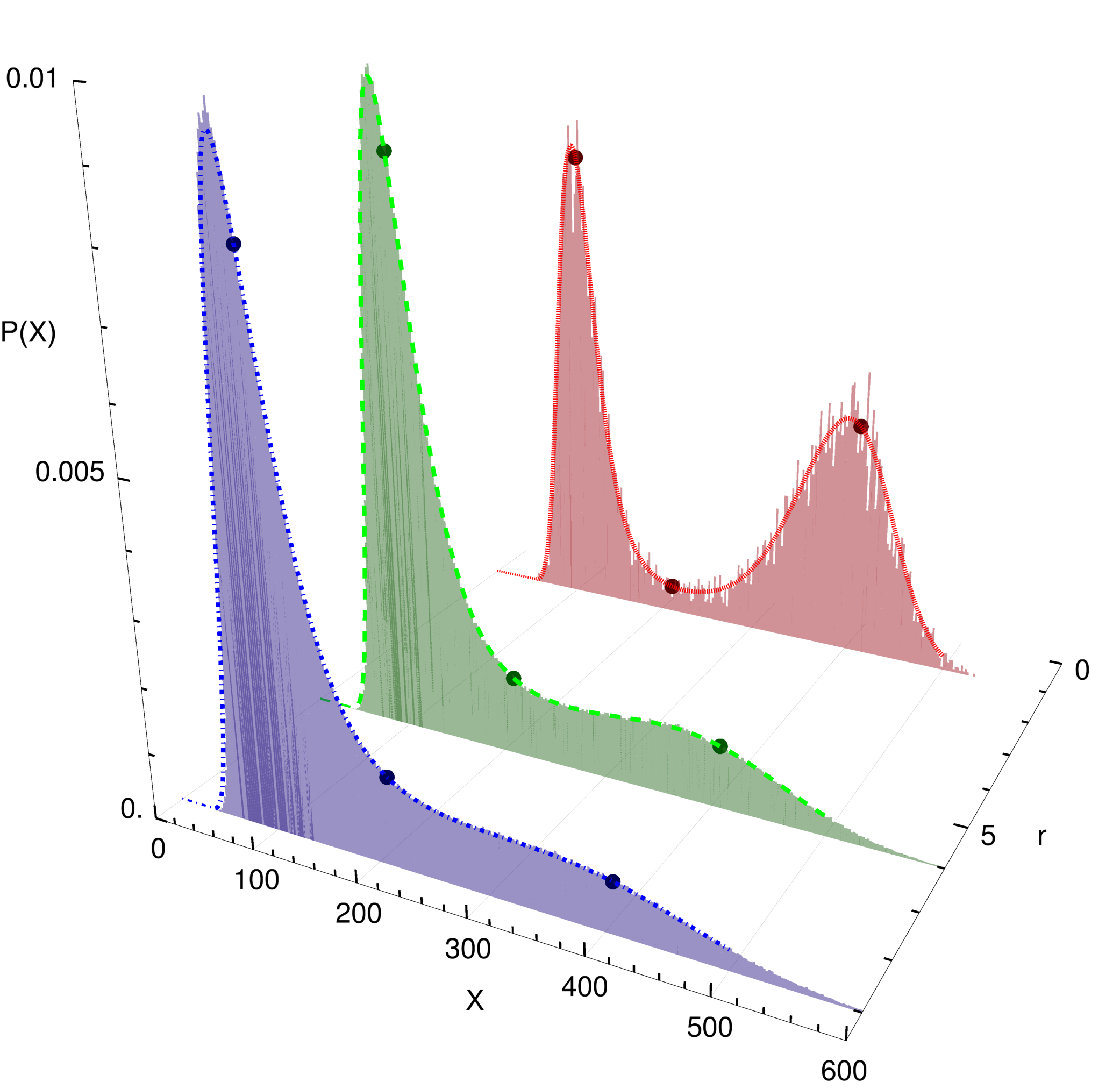
In other cases, increasing splits a single peak into two, creating bistability out of a deterministically monostable regime.
Why does this happen? The mechanism is transparent in the FPE framework. The maxima and minima of the stationary distribution are determined by the condition
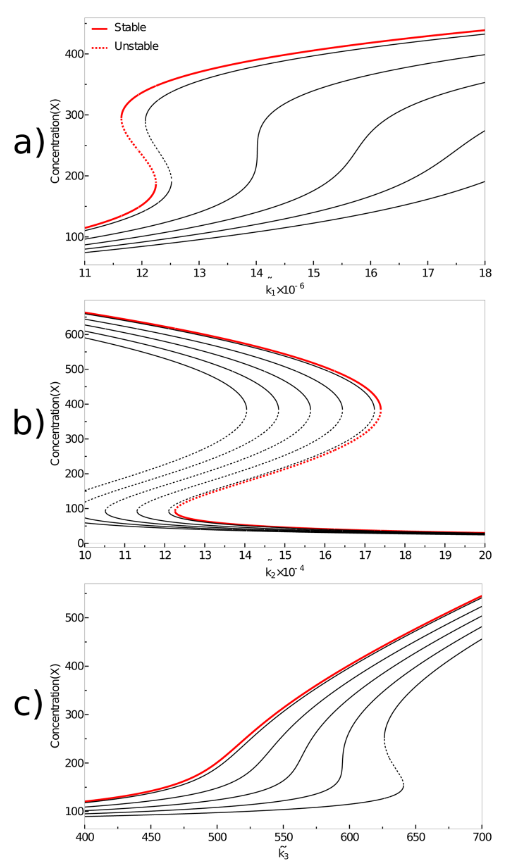
When changes with but does not, the roots of this equation shift. Using the implicit function theorem, we derived analytical expressions for exactly how much each bifurcation point moves per unit of burst size, as a function of the molecule number at that point. These expressions explain features such as the equal spacing between the bifurcation curves in Figure 2(b) directly from the math.
Time Series of Switches Between Two States
For a parameter set that is monostable at (the system fluctuates around a single fixed point near ), we increased the burst size to . The stochastic trajectory shows how bistability manifests itself in our system: the system fluctuates around for a while, then jumps to , then back again. The observed time scales are significantly longer than the intrinsic relaxation time.
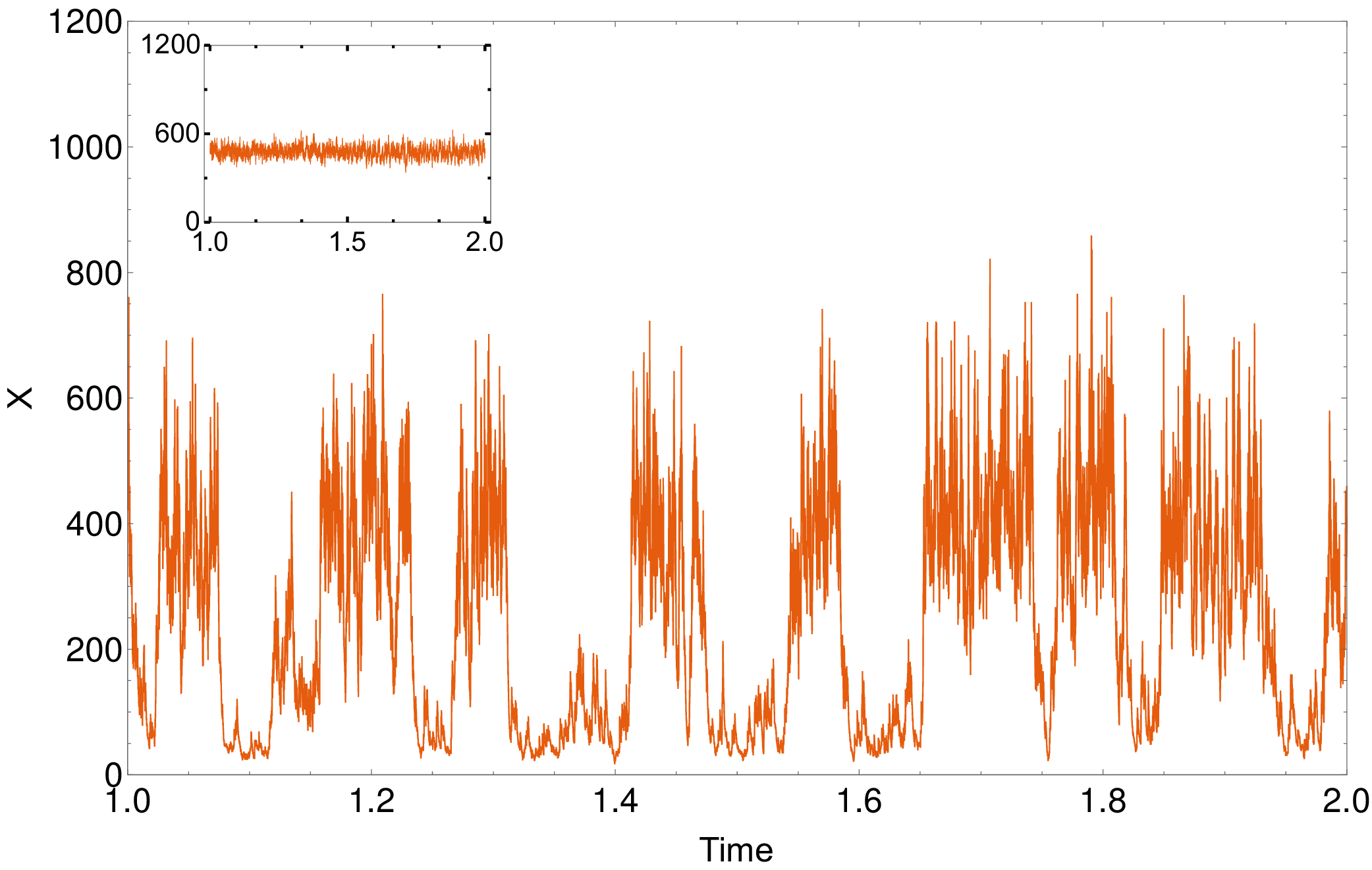
This is noise-induced bistability, which is not caused by a reduction in the number of molecules or the addition of an external signal, but solely by making the production bursty.
Why this is significant beyond chemical kinetics
We believe that these results have implications that extend far beyond the Schlögl model.
The conventional wisdom is that bistability is a property of the network topology of the reaction system: of which reactions are present and how they interact. Our results show that the temporal pattern of those reactions matters too. Even a system whose average dynamics is monostable can be driven into a bistable regime by bursty noise, and vice versa.
Bursty dynamics occur in semiconductor noise, where they lead to spectral deviations in the low-frequency range in NPN and PNP transistors; in population dynamics, where reproduction in bursts influences extinction probabilities; and are ubiquitous in gene regulation. In each of these contexts, a change in the burstiness of a process—for example, due to a regulatory mechanism or an environmental disturbance—could qualitatively alter the system’s stability landscape.
The Fokker–Planck model we use is analytically manageable precisely because it is one-dimensional and minimalistic. A clear minimal model makes it possible to isolate mechanisms, derive analytical predictions, and develop an intuitive understanding before turning to the full complexity of real biological networks.
What’s Next
Our analysis is limited to one-dimensional systems and the FPE approximation, which yields good results for a moderate number of molecules. Several obvious extensions are possible. Two-dimensional systems already exhibit noise-induced oscillations and Hopf bifurcations that are absent in their deterministic counterparts; so it would be fascinating to investigate whether burst noise can trigger these as well. And as single-cell measurement techniques continue to improve, experimental evidence of burst-noise-induced bistability should, in principle, become detectable.
The minimal model is a starting point, not an end goal. But sometimes the simplest possible case is exactly what is needed to clearly understand the mechanism.
Frequently Asked Questions
Can noise alone create or destroy bistability?
Yes. In the Schlögl model, changing the burst size of molecular production reshapes the stationary probability distribution while leaving the deterministic ODE untouched. The system can move from one stable state to two, or collapse from two back to one, even though its average dynamics never change.
What is burst noise?
Burst noise describes production that arrives in large discrete bundles rather than one unit at a time. In cells, a single transcription event can release tens or hundreds of protein copies at once. Each event carries more weight, so the same mean production rate generates much stronger fluctuations.
Why does burst size act as a bifurcation parameter?
Increasing the burst size amplifies the Fokker-Planck diffusion term but leaves the drift unchanged. The extrema of the stationary distribution sit where , so changing alone moves them, which can add or remove a peak.