Network location and clustering of genetic mutations determine chronicity in a stylized model of genetic diseases
Piotr Nyczka, Johannes Falk, Marc-Thorsten Hütt
Scientific Reports 12 (1), 19906 (2022)
Abstract
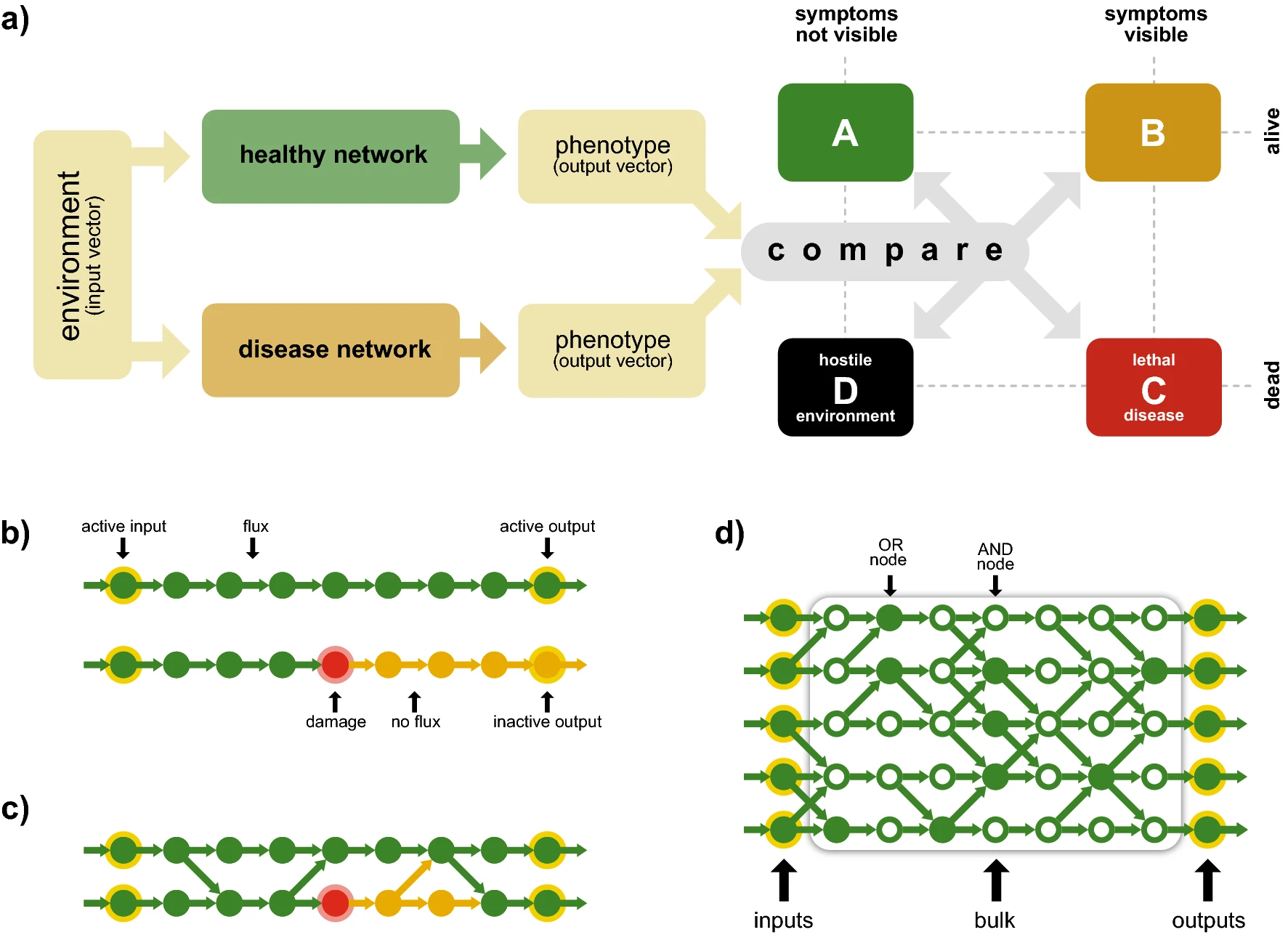
In a highly simplified view, a disease can be seen as the phenotype emerging from the interplay of genetic predisposition and fluctuating environmental stimuli. We formalize this situation in a minimal model, where a network (representing cellular regulation) serves as an interface between an input layer (representing environment) and an output layer (representing functional phenotype). Genetic predisposition for a disease is represented as a loss of function of some network nodes. Reduced, but non-zero, output indicates disease. The simplicity of this genetic disease model and its deep relationship to percolation theory allows us to understand the interplay between disease, network topology and the location and clusters of affected network nodes. We find that our model generates two different characteristics of diseases, which can be interpreted as chronic and acute diseases. In its stylized form, our model provides a new view on the relationship between genetic mutations and the type and severity of a disease.
Key Figure
About this publication
Cite this publication
@article{nyczka2022network,
  author = {Nyczka, Piotr and Falk, Johannes and Hütt, Marc-Thorsten},
  title = {Network location and clustering of genetic mutations determine chronicity in a stylized model of genetic diseases},
  journal = {Scientific Reports},
  volume = {12},
  number = {1},
  pages = {19906},
  year = {2022},
  publisher = {Nature Publishing Group UK London}
}
Share this publication
ShareRelated Publications
- Categories of important edges in dynamics on graphs
- Structural insulators and promotors in networks under generic problem-solving dynamic
- Nucleation transitions in polycontextural networks toward consensus
- Collective patterns and stable misunderstandings in networks striving for consensus without a common value system
- Physics is organized around transformations connecting contextures in a polycontextural world