Categories of important edges in dynamics on graphs
Dzmitry Rumiantsau, Johannes Falk, Piotr Nyczka, Marc-Thorsten Hütt
Royal Society Open Science 12 (4) (2025)
Abstract
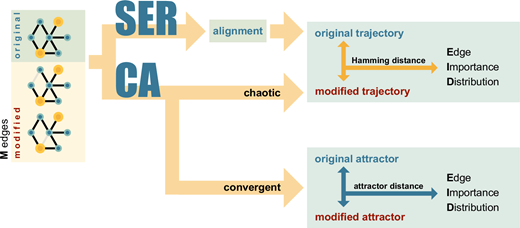
How important is a single edge of a graph for a specific dynamical task? This question is of practical relevance to many research fields and is pivotal to understanding the structure–function relationships in complex networks more deeply. Here, we design an analysis strategy to answer it and explore the connection of such importance to network topology. Our approach for evaluating dynamical edge importance is based on the differences in time courses between dynamics on the original graph and on the graph missing an edge. To demonstrate the method’s versatility, we apply it to two drastically different classes of dynamics—a minimal model of excitable dynamics, and totalistic cellular automata on graphs as representatives of pattern formation. Our results suggest that the dynamical usage of a graph relies on markedly different topological attributes for these two classes of processes. Finally, we study dynamical edge importance in the macaque cortical area network, to illustrate possible real-world applications. We find that dynamical importance of edges differ between the network and its switch-randomized counterparts, and these differences can be functionally interpreted. Moreover, they are qualitatively distinct for long-time courses and short transients, highlighting different parts of the network’s intended function.
Key Figure
About this publication
Cite this publication
@article{rumiantsau2025categories,
  author = {Rumiantsau, Dzmitry and Falk, Johannes and Nyczka, Piotr and Hütt, Marc-Thorsten},
  title = {Categories of important edges in dynamics on graphs},
  journal = {Royal Society Open Science},
  volume = {12},
  number = {4},
  year = {2025},
  publisher = {The Royal Society}
}
Share this publication
ShareRelated Publications
- Structural insulators and promotors in networks under generic problem-solving dynamic
- Nucleation transitions in polycontextural networks toward consensus
- Collective patterns and stable misunderstandings in networks striving for consensus without a common value system
- Network location and clustering of genetic mutations determine chronicity in a stylized model of genetic diseases
- Physics is organized around transformations connecting contextures in a polycontextural world